

In my previous post, I showed how floating-point non-associativity can create reproducible fingerprints of ML production methods1. A Verifier can catch misreporting by replaying claimed workloads on their own machine and comparing results.
But I hand-waved away a key problem: bitwise replay precision requires identical hardware. In international treaty verification, the Prover likely controls the supply chain for their accelerator type. If you need TPUv7 to verify Google’s server activity records, you’re getting that hardware (and its software) from a supply chain the Prover controls. The hardware and software stack is opaque to the Verifier, as it is confidential IP, and even with full transparency the system would still be way too complicated for the Verifier to rule out backdoors and collusion with the Prover.2
So how can you use hardware for verification if you can not trust it?
A solution: By controlling which information it has access to.
TLDR of the idea:
Use both a trusted (noisy), and an untrusted (precise) replay device (“TRD” and “URD”, respectively). Use the TRD to reduce the attack surface for communication with the untrusted device. Then, give the URD only the claimed inputs, and make sure there are only controlled information channels in and out of said device. A network tap on that controlled channel does the comparison of the replay with the Prover’s claimed outputs, without revealing sensitive secrets to the Verifier. The URD never knows what output the Prover claimed!
The gap in statistical verification
Recall the threat model: the Prover operates an AI datacenter under external scrutiny. They must report3 all their ML workloads faithfully. The Verifier re-executes random samples on a verification cluster to catch inconsistent reports.
In the previous post I emphasized that
Inference outputs are bitwise-reproducible within a production method
Different production methods often have detectably different fingerprints
Cross-hardware replay masks the more subtle differences (like batch size or tensor parallelism) but catches algorithmic changes (like attention variant or quantization)
This is in agreement with results from Karvonen et al., who developed a statistical verification method that measures token and activation divergence from a reference implementation. Their approach (prefill replay to verify decode generations) successfully detects the properties I also found to be detectable without needing to match the exact production method.
There is some noise, however: approximately 2% of token predictions do not match.4 This exceeds the fragile fingerprint of some of the properties a verifier may care about, like the absence of secret batch elements.
There is another reason why you might want noiseless verification:
Suppose we want to prevent a Prover from secretly using their ML hardware for undeclared computation. Network taps5 are installed at all I/O channels connecting a server/rack/pod with the outside world, and by extension, the Prover.6 In theory, this would prevent the Prover from interacting with their devices secretly. Any communication could be sampled and checked by either the Verifier or –more likely– trusted hardware that keeps datacenter traffic confidential from the Verifier. The problem here would be in the “checking” part. If it is not precise enough, the Prover (or even someone trying to steal the Prover’s secrets) may have exploitable degrees of freedom for steganographic communication that can pass off as “legitimate noise”. If every flipped token is a bit, then 0.5% of token selection flipped deliberately could hide below the noise floor of replay techniques such as Token-DiFR. For an NVIDIA SuperPOD producing 50 billion tokens/day, that would be 250 Mbits/day of covert bandwidth, or ~ 15-16 million tokens/day.
Finally, bitwise replay can settle disputes when statistical verification raises false alarm due to “freak outlier“ fluctuations in replay.
Setup
So if you want bitwise replay precision, you need to run verification on hardware you do not trust.7 There is a workaround that can still make it possible to let untrusted accelerators credibly verify the Prover’s claims:
We use two replay devices, network taps, and an external trusted computing base (TCB).8
The Trusted Replay Device (TRD) is a server the Verifier trusts9 because they control its supply chain. It does not need to match the Prover’s hardware SKU. Statistical verification is sufficient here; the TRD catches inconsistencies outside noise tolerance via prefill or other efficient replay methods.
The Untrusted Replay Device (URD) matches the Prover’s hardware SKU exactly, enabling bitwise replay if the production method is reported correctly by the Prover and imitated by the URD. The Verifier suspects the URD will collude with the Prover “at any chance it gets”.
Network taps and the TCB provide full monitoring on all I/O of the replay devices.10 The TCB sits on the URD’s network tap, forwarding only the Prover’s claimed inputs (e.g. tokens and production method metadata). It performs the bitwise comparison itself, based on the Prover’s claim and the URD’s calculation.
The feasibility of isolating the URD relies on what Harack et al. (2025) term a “Digital Perimeter” (Section 2.5.2.4). The network taps and TCBs (what they call “gateway machines”, see Section 2.5.2.3) generate cryptographic commitments on all inputs and outputs. This allows us to treat the accelerator as a black box; as Harack et al. note, this approach makes it possible to “make verifiable claims even if untrusted hardware... is doing the heavy lifting” (Section 2.5). This eliminates the need for trusted execution environments (TEEs) on the GPUs themselves, which are often absent and generally insufficient to defend against nation-state-level supply chain attacks.
Protocol
The Prover commits record hashes covering inputs, claimed outputs, and production method metadata. This includes batch composition (which requests were processed together) to account for dynamic batching (He & Lab, 2025), as well as sampling seeds and all other relevant information.
The TRD receives the Prover’s claimed inputs and the claimed outputs.11 It runs prefill or teacher-forced replay and attests approval or dispute according to tolerance criteria anchored to the pre-calibrated “noisiness” of the TRD’s replay.
The TCB at the URD’s network taps receives the Prover’s records but forwards only the inputs to the URD. The URD produces outputs and returns them to the TCB, which compares them against the Prover’s committed claims. They should match bitwise.
The URD never sees the claimed outputs!
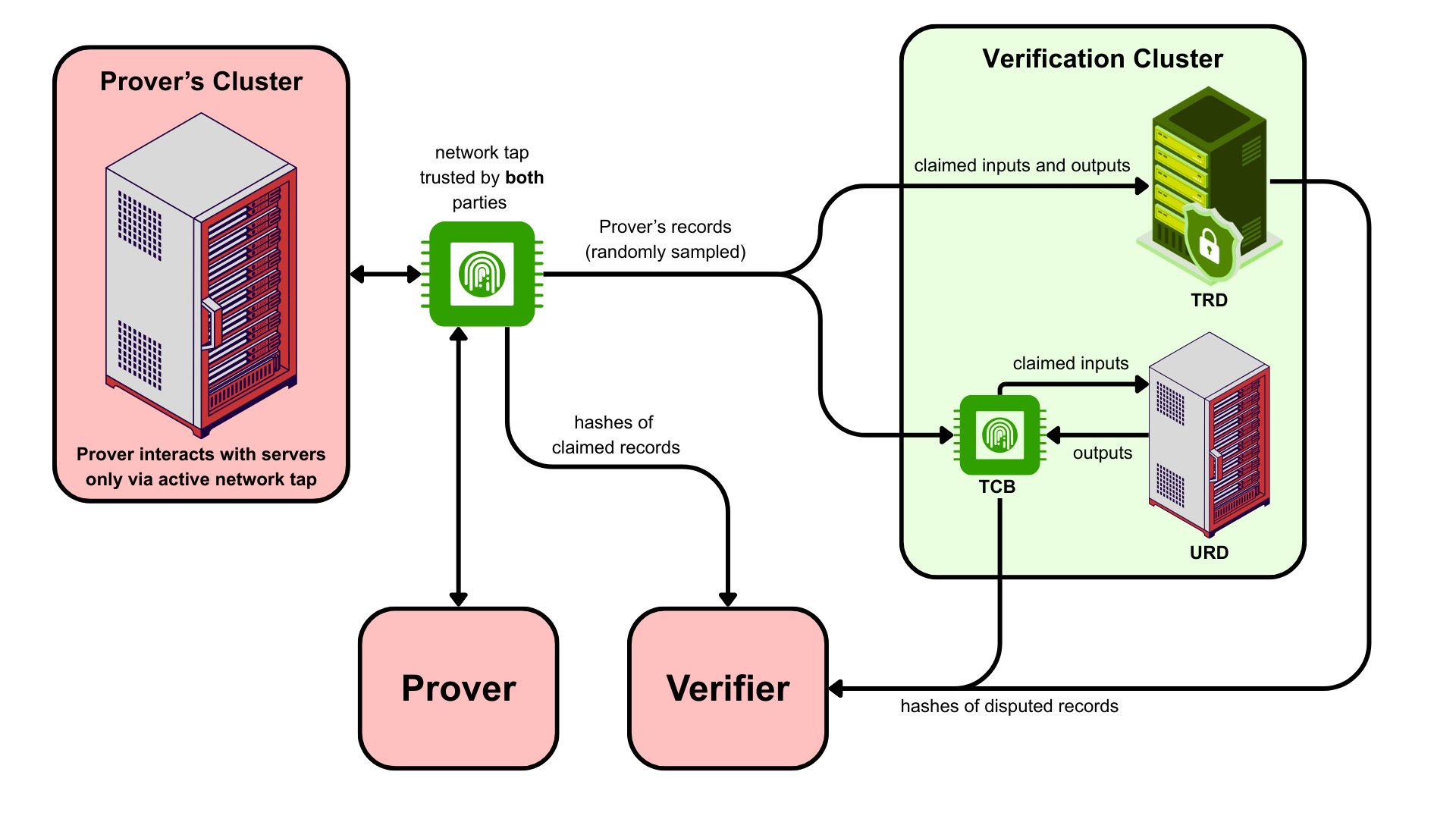
Illustration of the working principle. All devices carrying or processing sensitive information are air-gapped and under physical monitoring to defend against exfiltration of secrets. The colour coding represents untrusted vs. mutually trusted. An alternative setup could have a TRD that is untrusted by the Prover, and similarly gated by a mutually trusted TCB and air-gapping.
Defending against the Prover
Consider the attack vectors available to the Prover.
A false claim outside the TRD’s noise tolerance is caught immediately by the TRD. A false claim within noise tolerance will fail at the URD: the URD replays from inputs alone and produces the true output, which will not match the false claim bitwise. The TCB catches this.
What about collusion with the URD via the input data? The Prover controls the URD’s supply chain, so they could embed a backdoor accessible through the tokens the TCB passes on to the URD. But the URD can only receive information through those tokens. Even if the Prover could activate a backdoor via input steganography, they would need to communicate the desired fake output to the URD through those same inputs. And that fake output would still need to pass the TRD’s noise tolerance check.
This is an extremely constrained attack surface. You could close it entirely by requiring the Prover’s records to contain more detailed, reproducible information about the outputs. Just enough (compressed activations or similar) to ensure this information never fits into the noise tolerance of the TRD replay.
Defending against the Verifier
The setup and procedure must also prevent the Verifier from exfiltrating the Prover’s secrets (model weights, proprietary inference optimizations, or training data, customer data) from the Prover’s servers or from the replay devices.
You could do this by isolating interactions: The Verifier interacts with replay devices only during initial setup, before they contain secrets. During replay, communication from the Prover’s servers to the replay devices flows exclusively through mutually trusted network taps. There is no information disclosure except for the TCB-attested hashes of the approved records.12
Up Next
This post focused on the replay devices’ trust-precision dilemma.
Careful readers might have seen this symbol in the illustration above and wondered:

How do you get mutually trusted, sufficiently performant TCBs and network taps?
How do network taps handle the full complexity of datacenter traffic? Not just tokens, but the JSON packaging, https, SSH, diagnostics, and everything else crossing the edge?
Indeed, this device is the critical trust anchor of the security protocol and deserves its own deep dive. It will take us through AI datacenter network topology and communication types, FPGAs and other specialized hardware, and technical precedents in high-frequency trading and military network security.
Stay tuned.
I defined the meaning of the term “production methods” in detail in said post.
See Verification for International AI Governance, section 2.2.3.3.
Via cryptographic commitments. The records stay confidential and will be screened automatically.
For the Token-DiFR method, that is.
To keep it simple and more tractable, the taps might only be installed at the relatively low-traffic north-south parts of the datacenter network, and maybe the storage fabric. More details on this soon.
Physical side-channels are mitigated by physically monitoring the hardware to ensure air-gapping. The details of how to operationalize this are important, but out of scope here.
You can not peek under the hood and scrutinize the hardware and data to make them trustworthy, because of confidentiality. More concretely, a Chinese or American Prover would likely object to sharing every detail of their AI hardware and firmware with foreign Verifiers, and vice-versa.
Again, we aim to preserve confidentiality of the Provers’ records and trade secrets, while still verifying them. The replay devices can not reveal arbitrary information to the Verifier. More on that in the “Protocol” section.
Optionally, the prover as well. On the one hand, this may be necessary to allow any information to leave the TRD. On the other hand, this would complicate supply chain security and practicality, and could be handled by a TCB gateway as it is for the URD.
Device-internal compute fabric does not need monitoring, only air-gapping from anything other than the components considered “part of the device”.
There is a completely different setup in which you would also want/need replay: Instead of requiring the Prover to declare their workloads proactively, the verification system taps into the Prover’s communication with their servers and obtains the records directly. Replay would then only need to ensure that the monitored traffic does not contain steganography via tokens. But of course, north-south datacenter traffic is more than just tokens. In another post, I will detail how to deal with all the json packaging, HTTPs, SSH, diagnostics etc. that are all also part of the traffic crossing the datacenter edge.
There are ways to avoid the timing or order of the publication of these hashes becoming side-channels for information leakage to the Verifier. The Prover can add noise to the timing and the order can be fixed by the order of original commitment. A full protocol specification would address additional side channels, but the core principle holds: the Verifier learns only pass/fail until there is a genuine alarm.